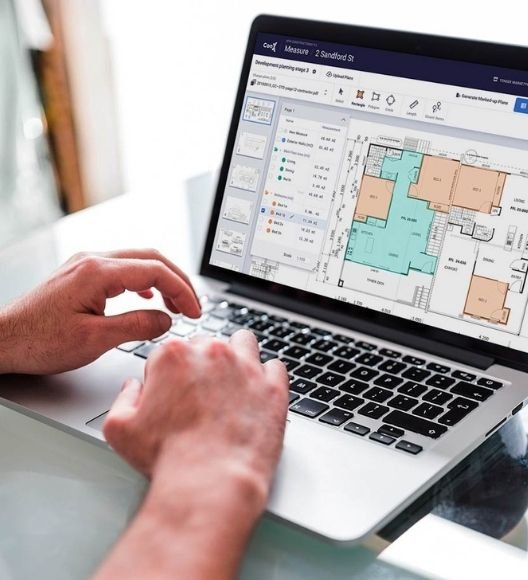
Every growing contractor reaches the same point. Bids are piling up, your people are working nights on takeoffs, and the obvious answer is to hire an estimator. Then you look at what that salary actually costs, and you hesitate.
That hesitation is reasonable. This post puts real numbers on both options, so you can choose with facts and not with a feeling.
What an in-house estimator really costs
The U.S. Bureau of Labor Statistics puts the median pay for a cost estimator at $78,740 a year (May 2025). For specialty trade contractors it is $80,330, and for building contractors $84,610.
Salary is not the whole cost. Across U.S. private industry, benefits make up about 30% of total compensation, which works out to $14.07 an hour in benefits on top of $32.82 an hour in wages (June 2026). That is roughly 43% on top of wages.
Apply that to the median salary and a typical in-house estimator costs about $112,500 a year, or around $9,400 a month. This is our own estimate from the two BLS figures, and an individual company’s real number will differ.
It still leaves out:
- Recruiting time. Finding a good estimator takes months.
- Software. Takeoff and estimating tools for each seat.
- Ramp-up. A new hire needs time to learn your standards.
- Slow weeks. You pay the same in a month with three bids as in a month with thirty.
- Single point of failure. When your estimator is sick, on leave or gone, the work stops.
What a remote estimator costs
You choose how much capacity to buy, which is the main difference.
| In-house hire | Part-time dedicated | Project-based | |
|---|---|---|---|
| Typical cost | about $9,400 a month (estimate above) | from $1,500 a month | from $200 per project |
| Commitment | Employment | Month to month | None |
| Starts in | Weeks to months | 24 to 72 hours | 24 to 48 hours |
| Scales with bids | No | Yes | Yes |
Full-time dedicated estimators are quoted individually, because the price depends on your trade and workload.
A fair warning: a part-time remote estimator is not a like-for-like replacement for a full-time employee. They give you set hours or days each week. What you gain is capacity that matches your bidding, and not a fixed salary on slow months.Locating the bores so they didn’t interfere with the building footprint was another challenge. The team successfully located 27 of the bores outside the footprint, with the remaining four bores falling underneath the building. Locating most of the bores outside of the building footprint kept the project on schedule, and limiting the number of bores beneath the foundation mat slab meant less impact to the deep foundation excavation activities.
When an in-house estimator is the right call
- You bid constantly, and the volume stays high all year.
- You need someone on site, in your office, or in meetings every day.
- Estimating is core to how you win work, and you want to build the department.
When a remote estimator makes more sense
- Your bid volume rises and falls with the season.
- You can’t yet justify a full salary, but your team is overloaded.
- You want to test a new trade or a new market without hiring for it.
- You need extra hands for a deadline, and a recruiting process takes too long.
Many contractors do both. They keep one in-house estimator for the core work and use a remote estimator for peaks.
Three questions to decide
- How many bids do you submit a month, and how much does it change? If it varies a lot, fixed salary is the expensive option.
- How long can you wait? A hire takes months. A remote estimator can start within days.
- What does a missed bid cost you? If one extra won project pays for months of help, capacity matters more than payroll.
How ABLE Estimating helps
Our team has delivered 500+ takeoffs and estimates since 2022, with one refund request in that time, and the people behind ABLE have worked in estimating for over a decade. Your estimator is screened and tested for accuracy, software skill and speed. They are onboarded to your standards and templates. There are no long-term contracts.
The easiest way to compare is to test us. A $200 trial project costs less than a day of an in-house salary, and you check the result against your own numbers.
Sources: U.S. Bureau of Labor Statistics, Occupational Outlook Handbook: Cost Estimators (May 2025 wage data) and Employer Costs for Employee Compensation, June 2026.
An in-house estimator costs the same in a slow month as in a busy one. Remote capacity should move with your bids.

Frequently asked questions
These sets of questionnaires and answers by experts can help get a better understanding of our remote estimator services, timeline & process.
Not always for the same hours. A remote estimator costs less for part-time capacity, because you pay for the hours you use, with no benefits, recruiting or idle weeks.
Yes. A project takeoff has no commitment, and you can move to part-time or full-time whenever it suits you.
Yes — if you specialize in a particular trade (concrete, electrical, HVAC, drywall, roofing, etc.), we can assign you a dedicated remote estimator experienced specifically in that trade, so you’re not training someone generalist on your specifics every time.
Part-time dedicated plans run month to month, so you can adjust as your workload changes.
We work overlapping hours with US time zones and stay available through whatever channel works best for you — email, phone, Slack, or Zoom. You’ll have direct access to your estimator, not a rotating help desk.
Working with a remote estimator typically saves 20-45% compared to a full-time in-house hire, depending on experience level — and you avoid the overhead of salary, benefits, insurance, equipment, and software licenses, since we cover all of that on our end.
No. You can engage us project-by-project, or on a quarterly or annual basis if you want consistent support — whatever fits how your bid pipeline actually flows. No long-term lock-in required.